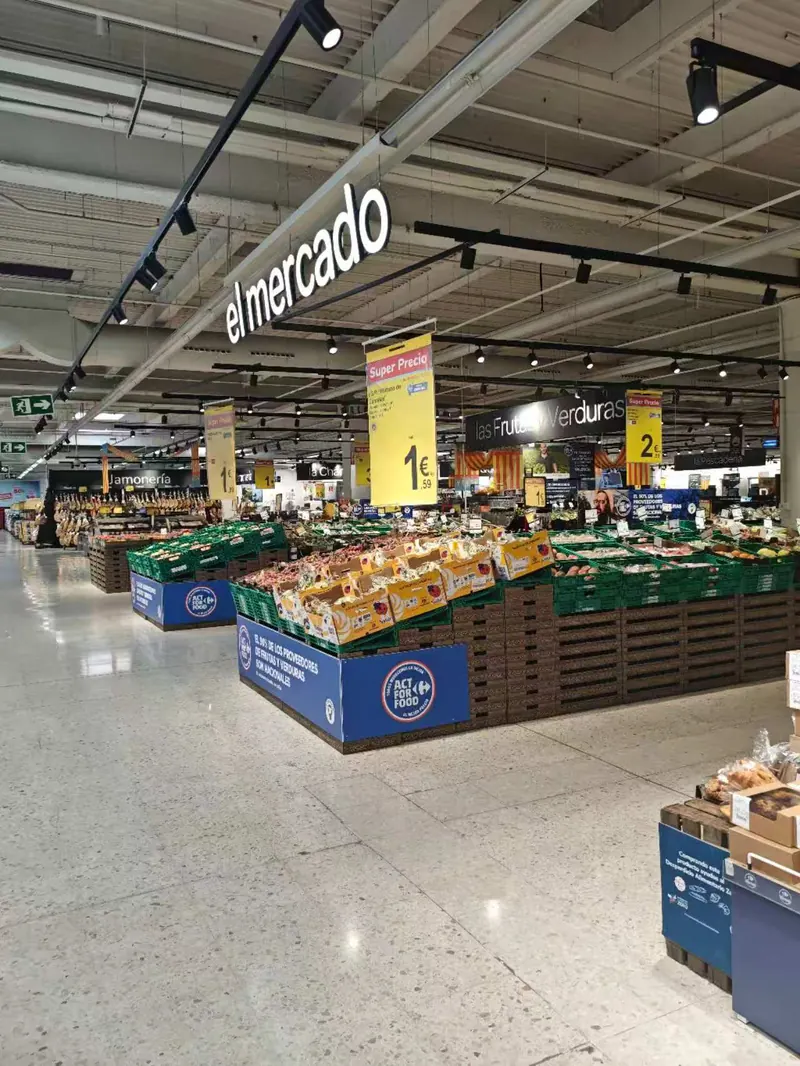
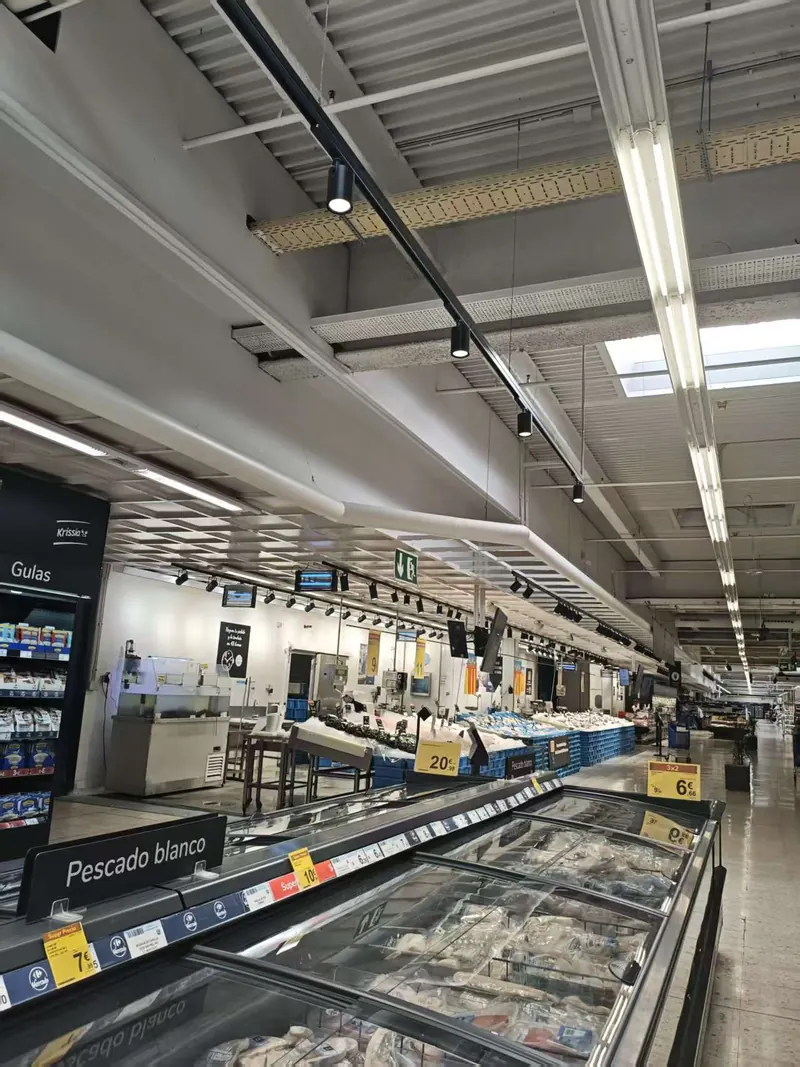
OEM track lighting for supermarket fresh food areas.
A black track system and cylindrical LED track spotlights, supplied as OEM for the fruit, vegetable and seafood counters of a European supermarket — where the merchandise has to look fresh under light that is aimed rather than simply increased.
Installation photographs supplied by our project partner. The supermarket, its operator and the contractor are not named — this project is strictly confidential.
THE BRIEF
Make the food look fresh, without lighting the whole floor to do it.
The project covers the fresh food area of a European supermarket: fruit, vegetables and seafood. It was delivered by our local partner, who specified the lighting design and needed an OEM manufacturer able to build the hardware to it.
Two requirements pulled against each other. Merchandise has to look as fresh and vibrant as it does at its best — that is the whole commercial point of a fresh food zone. And a large sales floor cannot be over-lit to get there, because every watt runs for the whole trading day and every extra fitting is another thing to maintain.
That combination is what the specification had to solve, and it is mostly solved by aim and colour temperature rather than by raw output.
WHAT WE SUPPLIED
Four parts of the specification.
01
Colour temperature per zone
A fresh food zone is not one lighting problem. White fish and shellfish on ice read cleanly under a higher colour temperature, while fruit and vegetables look better under warmer light that lifts reds, oranges and greens. We supplied the mix the design called for, taken from the 2700 K / 3000 K / 4000 K options published for this range — the zone, not the store, sets the colour temperature.
02
Targeted light instead of a brighter floor
The efficiency argument in a supermarket is mostly about where the light lands. Aimed track light puts illuminance on the merchandise and on the vertical face of a display, rather than raising the general level of an entire sales floor to reach the same result at the counter. Wattage and system output follow the ordered configuration, and both are published per model on the product pages.
03
Black track and cylindrical heads
The ceiling is exposed and industrial, and the track sits on it visibly. Black rail and black cylindrical heads keep the run reading as one continuous line across the ceiling instead of a row of fittings, with no visible brackets interrupting it.
04
Light on the counter, not in the shopper’s eyes
Produce and seafood counters are viewed from a standing position and often have glass in front of them. Deep-recessed optics keep the bright aperture out of the shopper’s line of sight and limit the light that would otherwise reflect off glass back at the customer.
HOW THE SUPPLY WORKED
Built to someone else’s lighting design.
The lighting design was the partner’s, and the specification that came out of it — colour temperature per zone, beam angles, wattage, finish, packaging — was what we manufactured to. As the OEM factory we do not take the end client relationship: distributors, contractors and brands keep their projects, and we supply the hardware and the documentation behind them.
Fresh food zones are also the least forgiving place for a changing article. A supermarket replaces or extends counters over time and expects the same light each time, so the confirmed specification becomes the reference for every following batch rather than a starting point to re-negotiate.
The supermarket, its operator, the location and the contractor stay confidential, and the project is described at the level of the lighting scope only.
You will not find an energy-saving percentage here either. A saving depends on the baseline the operator was running before, on tariffs and on trading hours — all of which are their data, not ours. What we publish is the part we can account for: the wattage and system output of each model on its product page, so the comparison can be made by whoever has the other half of the numbers.