
Market comparison · 2026-09-15
3-Phase vs Single-Phase Track: EU and China Retail
How supermarket lighting track differs between China and Europe: single-phase 3-wire versus 3-phase 4-wire, feed spacing, cable, losses and installation cost.
Direct answer
Supermarket lighting track is specified differently in China and Europe, and neither choice is simply cheaper. Chinese projects usually use a reinforced single-phase 3-wire track whose extruded channel carries its own weight, so no steel cable tray is welded above it. European projects usually use a 3-phase 4-wire track: it costs more per metre, but three live conductors sharing one neutral reduce conductor losses, allow longer runs between power feeds and cut on-site wiring.
Information as of September 2026. Standards, wiring rules and voltage-drop limits differ by country and must be confirmed for your project by a qualified electrical designer. This article is not legal or electrical design advice.
The two platforms at a glance
| China-typical: single-phase 3-wire structural channel | Europe-typical: 3-phase 4-wire track | |
|---|---|---|
| Live conductors | 1 | 3 (L1 / L2 / L3) |
| Neutral | 1, carrying full load current | 1 shared, carrying close to zero when phases are balanced |
| Protective earth | separate PE conductor (L / N / PE) | through the track housing |
| Switching groups from one rail | 1 | up to 3 |
| Ceiling support | the rail profile spans between suspension points — no separate steel cable tray or welded bridge | rail suspended directly from the structure — no cable tray required |
| Typical power-feed spacing | about 10 m (3–4 × 3 m rails per string) | 20 m and above |
| First cost | lower rail cost; on-site steelwork and welding removed | higher rail cost; less cable, fewer terminations, less site labour |
| Fits best | cost- and schedule-driven fit-outs | large stores, long runs, high connected load, scene control |
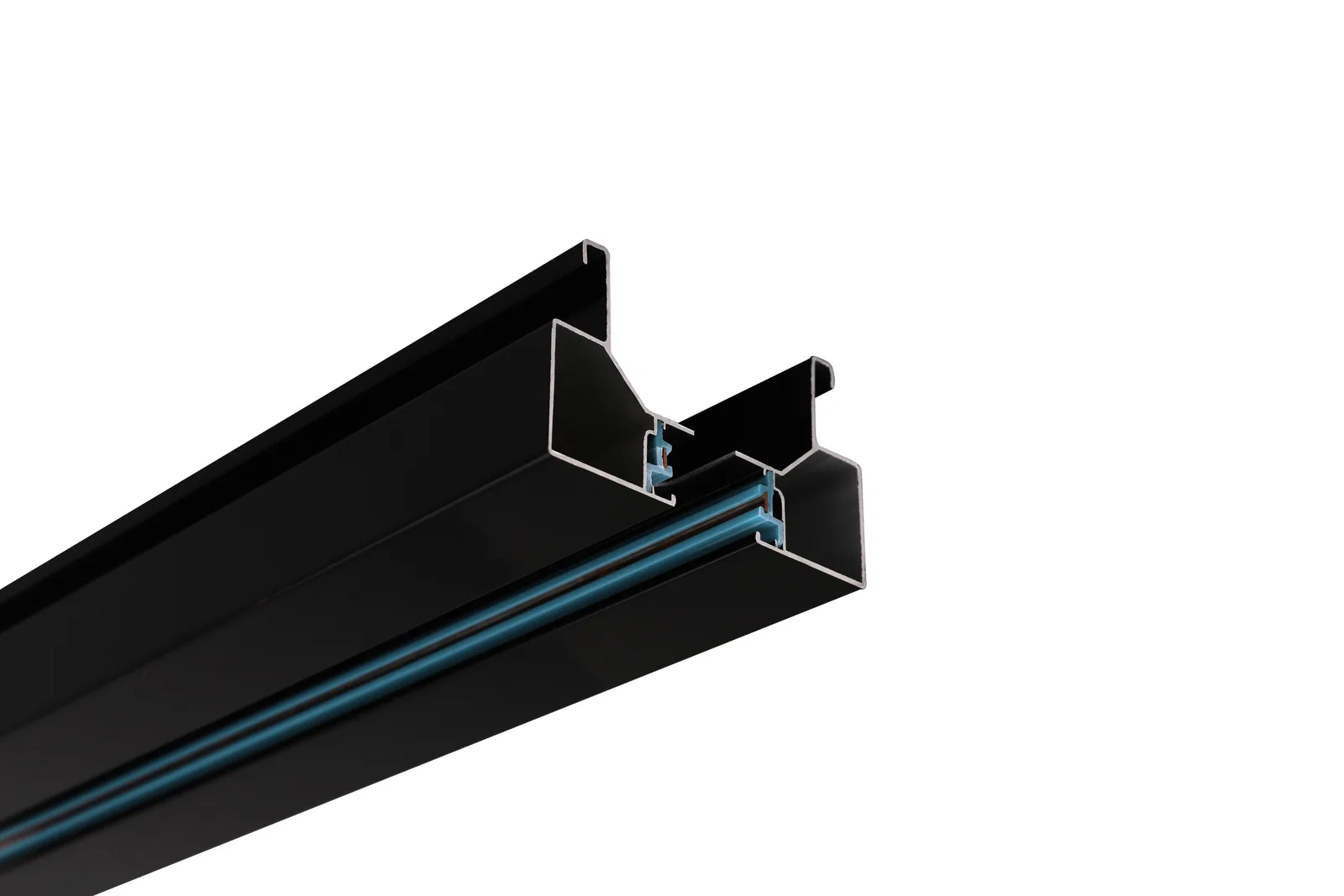
The Chinese platform: a structural single-phase 3-wire channel that carries its own weight between suspension points.
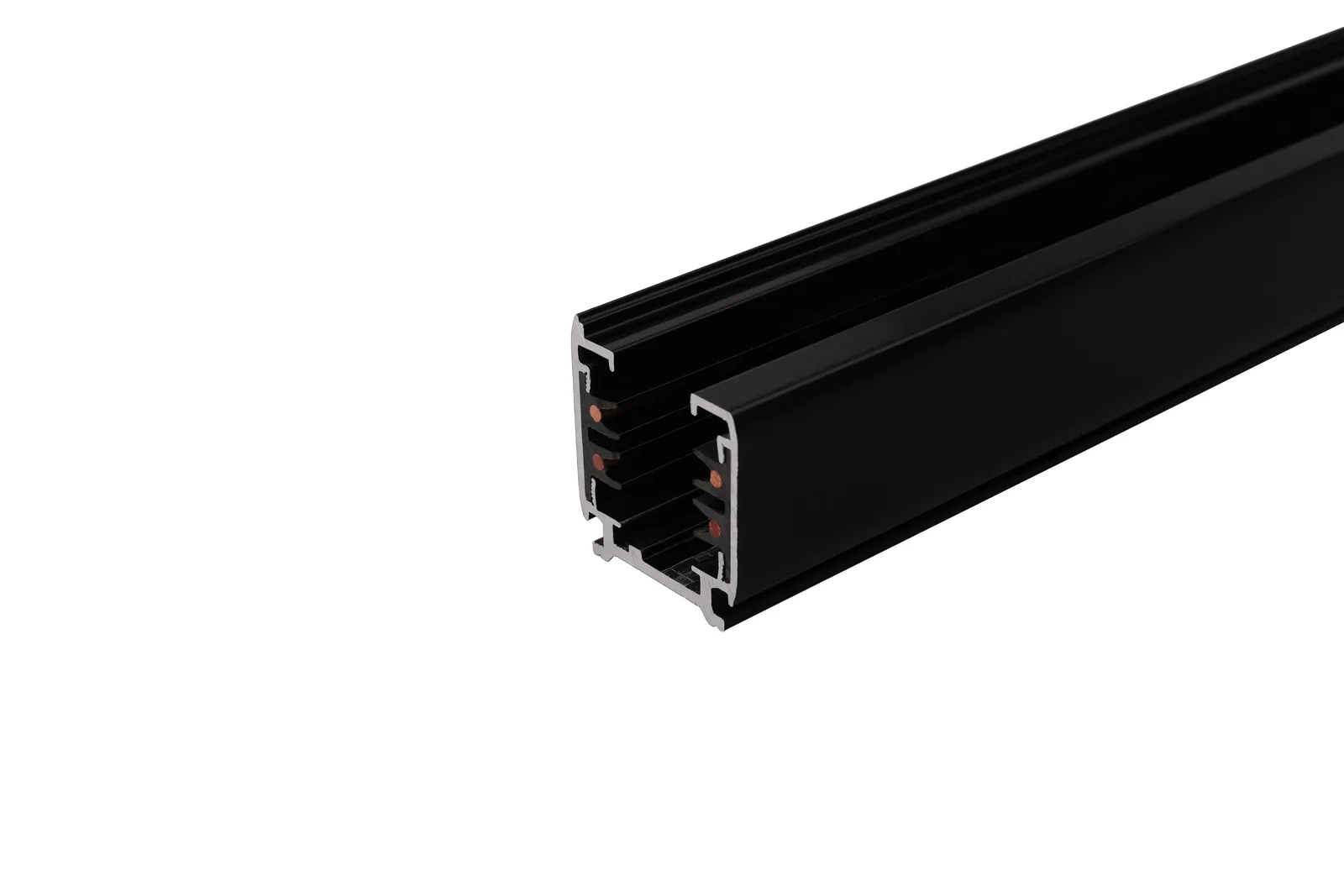
The European platform: 3-phase 4-wire track, with the protective earth taken through the housing.
Conductor arrangement, profile structure and earthing differ between platforms, and the two are not interchangeable at the adapter. Confirm the current drawing for your system before specifying.
Why Chinese supermarkets use a bridge-free 3-wire channel
At Chinese supermarket fit-out sites, an ordinary 3-wire track profile is light, so the installer normally adds a steel cable tray or support bridge above it — welded and assembled on site — before the track can be hung. That step consumes steel, welding equipment, hot-work permits and days of programme time, and it sits on the critical path before the store can open.
In 2018 the then general manager of HAOTAI, Yaohe Guo, proposed extending the company’s existing large-channel profile so that the track extrusion itself acts as the load-bearing member. The on-site bridge disappeared from the sequence.
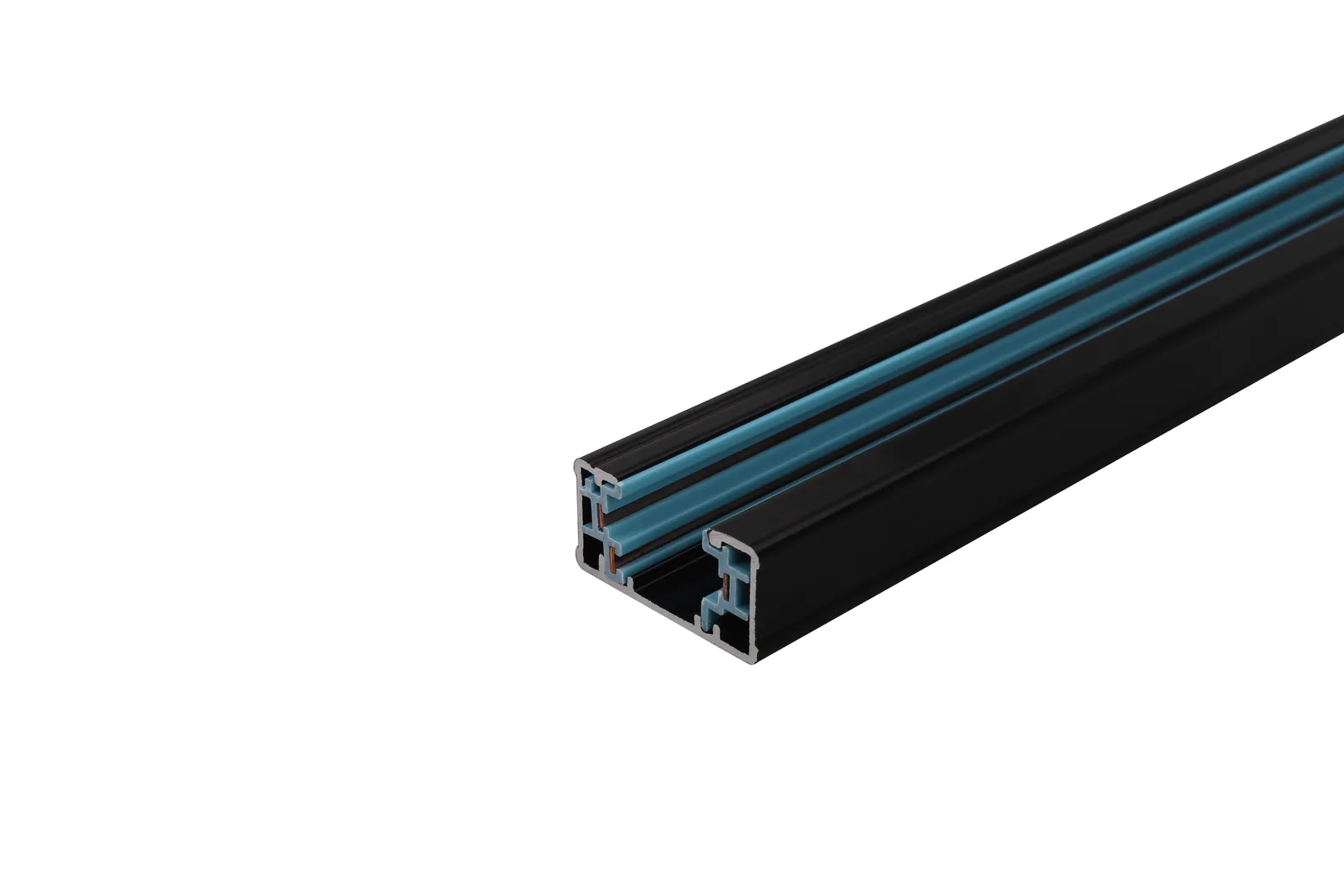
The large-channel profile the bridge-free design was developed from — the rail itself became the load-bearing member.
The trade-off is deliberate and small: the rail carries a little more aluminium, and the project gives up steel tray, welding and the labour that goes with them. In the Chinese market this family is known as the bridge-free track; because no settled English market term exists, we describe it by function rather than by product name.
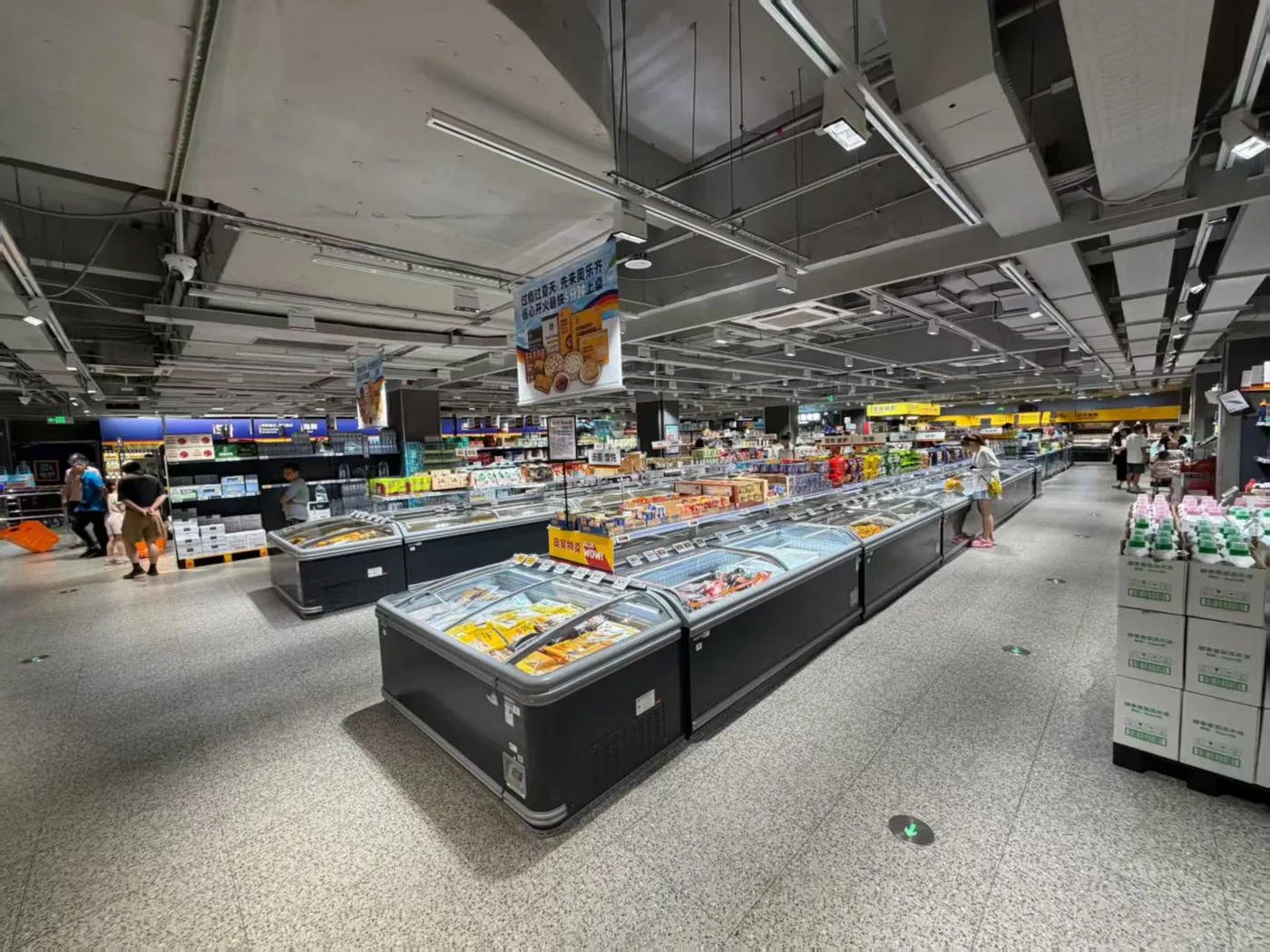
A Chinese supermarket ceiling: the track is suspended directly, with no welded steel bridge above it.
The effect on the programme is what interests project managers. A leading Chinese supermarket lighting engineering contractor we work with reports that lighting commissioning on this type of fit-out compressed from two weeks or more to 3–5 days, shortening the unopened-store period and the rent that runs with it.

The 17th China Scientists Forum, September 2020. The company’s registered manufacturing entity was named an advanced unit in Chinese scientific and technological innovation, and Yaohe Guo — then general manager of HAOTAI — received the invention achievement award for the track design. Award titles translated from the Chinese certificates.
Why Europe stays on 3-phase 4-wire track
In European retail specification the 3-phase 4-wire track is the established platform. The engineering argument behind that choice is straightforward:
- Load shared across three conductors. For the same total connected load, each live conductor carries about one third of the current. Loss rises with the square of current, so the rail runs cooler.
- One shared neutral instead of three. Three separate single-phase circuits need three neutrals. A balanced 3-phase circuit returns through a single neutral whose current largely cancels, so you stop paying for neutral copper that is not working.
- Longer runs, fewer feeds. Lower current per conductor means lower voltage drop per metre, which is why a 3-phase run commonly accepts a power feed every 20 m or more, where a single-phase layout in China typically needs one about every 10 m.
- Fewer feed points, fewer weak points. Fewer power-feed connectors, cable glands, junction boxes, cable runs and terminations — and fewer places for a fault to appear during commissioning.
- Scene control comes with the platform. The three live conductors double as three switched groups on the same rail, which is how one ceiling line carries general lighting, accent lighting and a night scene without a second rail. The LED track spotlights hung on it are then grouped by circuit rather than by rail.
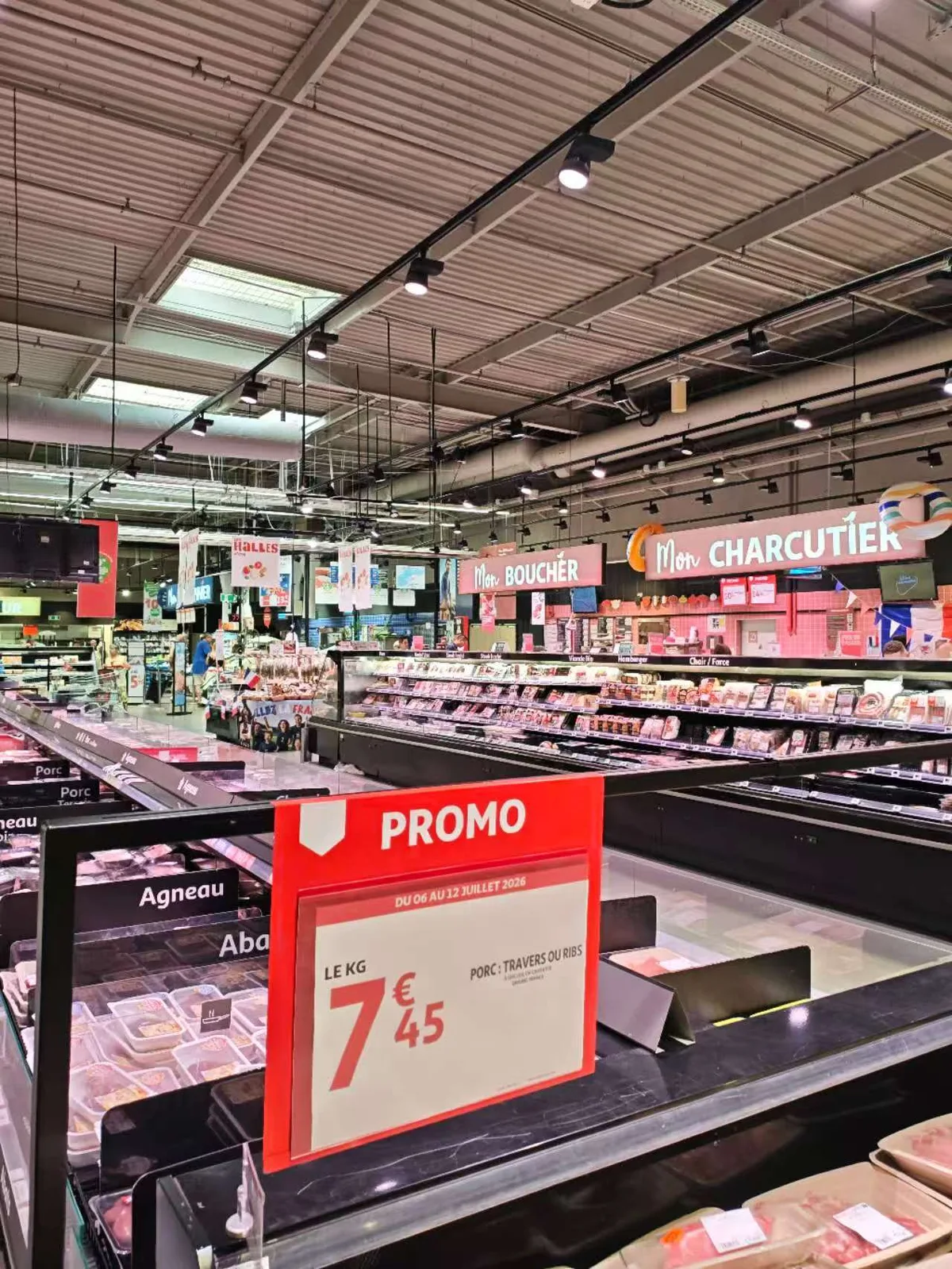
A European retail ceiling: 3-phase track suspended directly from the structure, with no cable tray.
Where this argument does not apply. The neutral saving assumes the three phases are loaded together and reasonably balanced. A scene-controlled installation that energises one circuit at a time has no balance, and the shared neutral then carries the full current of that circuit. LED drivers are also non-linear loads, and their third and other triplen harmonics add in the neutral instead of cancelling, which is why neutral sizing in 3-phase 4-wire lighting circuits must be calculated rather than assumed. Ask your electrical designer to size the neutral for the actual driver mix.
The electrical difference in numbers
Idealised comparison: same total connected load, same rail length, equal conductor cross-section, balanced 3-phase load.
| Single-phase 3-wire | Balanced 3-phase 4-wire | |
|---|---|---|
| Current per live conductor | I | ≈ I ÷ 3 |
| Voltage drop per metre | reference | ≈ one third |
| Live-conductor loss | I²R per conductor | (I ÷ 3)²R per conductor |
| Neutral loss | I²R at full load current | ≈ 0 when balanced |
| Total conductor loss | 2I²R | ≈ I²R ÷ 3 |
For the same delivered load, the 3-phase arrangement loses roughly one sixth as much energy in the conductors of the same rail. Treat this as a directional calculation, not a measured result: the real figure depends on the profile, the conductor cross-section and how evenly the load is distributed. Over a ten-year store life the difference is paid for continuously, in heat in the ceiling and in electricity.
Worked example: a 3,000 m² supermarket with 1,500 m of track
This is a planning model, not a quotation. Prices are deliberately excluded — insert your own quoted figures.
Assumptions:
- 3,000 m² sales floor with 1,500 m of track
- 2.5 mm² copper feed cable
- average feed cable run of 15 m between the rail and the distribution point (replace with your own measurement)
| One feed / 10 m (China-typical) | One feed / 20 m (Europe-typical) | One feed / 30 m | |
|---|---|---|---|
| Power feeds on 1,500 m | 150 | 75 | 50 |
| Feed cable at 15 m average | 2,250 m | 1,125 m | 750 m |
| Copper in feed cable (2.5 mm², 3-core) | ≈ 151 kg | ≈ 76 kg | ≈ 50 kg |
| Power-feed connectors, glands, junction boxes | 150 sets | 75 sets | 50 sets |
| Termination labour at 0.5–1.0 h per feed | 75–150 h | 38–75 h | 25–50 h |
Sensitivity to the average feed run — the extra cable and copper a 10 m layout needs compared with a 20 m layout:
| Average feed run | Extra cable | Extra copper (3-core 2.5 mm²) |
|---|---|---|
| 8 m | 600 m | ≈ 40 kg |
| 10 m | 750 m | ≈ 50 kg |
| 15 m | 1,125 m | ≈ 76 kg |
| 20 m | 1,500 m | ≈ 101 kg |
| 25 m | 1,875 m | ≈ 126 kg |
Turning it into money:
Extra installation cost of the 10 m layout ≈ 75 × (power-feed connector + gland + junction box) + 1,125 m × cable price per metre + 38–75 × electrician hourly rate, plus the cable support needed for the extra cable.
Break-even = that total ÷ 1,500 m. The result is the per-metre rail premium at which the two platforms cost the same to install. If the 3-phase rail premium you are quoted sits below that number, the European platform wins on first cost as well as on losses.
The Chinese comparison does not disappear in that arithmetic. Removing the steel tray and its welding from the programme is normally a larger saving than the cabling difference above, which is why the bridge-free channel remains the default in China. Each market optimised the cost that dominated its own sites: China removed steelwork and site time, Europe removed cable, terminations and losses.
How to choose for a project
- Building in China, where cost and opening date dominate → the bridge-free single-phase 3-wire channel. Fewer trades on site, no hot work, shorter programme.
- Building in Europe, with a large floor area, long runs and high connected load → 3-phase 4-wire track. Accept the rail premium and take back cable, terminations, losses and site hours.
- Needing several scenes from one ceiling line → 3-phase track, or a 3-phase DALI platform where control wiring is required.
- Either market → confirm the voltage-drop calculation, the per-circuit current rating, the earthing arrangement, the suspension spacing and load, and the rail, adapter and luminaire as one system before ordering. See the buyer FAQ for the questions to put to a supplier.
Track platforms HAOTAI supplies
Both approaches sit in the HAOTAI range, so the choice can follow the project rather than the supplier:
| Platform | Typical market use |
|---|---|
| F0350 3-wire single-circuit track | single-phase store and public-interior layouts |
| F0440 4-wire three-circuit track (surface and recessed) | European retail and project specification |
| 6T series 3-phase DALI track system | multi-conductor export platform for DALI-oriented configurations |
The bridge-free development is a profile-engineering result, and it is the reason we are confident about the European platform rather than a substitute for it. A supplier that can redesign an extrusion until it becomes load-bearing is the same supplier you want holding the tolerances, conductor positions and adapter geometry of a 3-phase 4-wire system. For European projects we recommend and supply the 3-phase 4-wire platform, not a cheaper single-phase channel.
The F02 2-wire, F03 3-wire and F04 4F / 4Y wired track systems are supplied under the manufacturer’s certified track-system platform, with the certificate and test-report set for your exact configuration. For the structural channel used in the Chinese market, confirm the certification route your market requires with our sales team before the project is priced. The full rail, connector and adapter range is listed under lighting track rails.
Frequently asked questions
Is 3-phase track the same as three-circuit track?
Not exactly, and the difference matters commercially. A 3-phase 4-wire track has three live conductors (L1, L2, L3) plus one shared neutral. Because the three live conductors can be switched separately, one rail can serve up to three lighting groups — which is why the platform is often described as three-circuit. Three-circuit describes the switching; 3-phase describes how the load is distributed and how the neutral is shared. The single-circuit vs three-circuit guide covers the switching side in more detail.
How does earthing differ between the two platforms?
On the 3-wire single-phase track the protective earth is a separate conductor alongside live and neutral. On the 3-phase 4-wire track the earth is taken through the housing. That difference matters at the connector and adapter, and it is one of the reasons rail, adapter and luminaire have to be bought as one system. Confirm the arrangement on the current drawing for your platform.
Does 3-phase track really use less copper?
In the neutral, yes. Three separate single-phase circuits need three neutrals; a balanced 3-phase circuit returns through one shared neutral whose current largely cancels. There is also less copper in the feed cabling, because fewer feeds are needed over the same run. The saving depends on load balance and harmonic content, so confirm neutral sizing with your electrical designer.
Can a bridge-free Chinese track be used on a European project?
Do not assume it. The rail has to satisfy the standard and certification route your market requires, and the earthing and conductor arrangement must match the drawing. HAOTAI’s wired track systems are supplied with the certificate and test-report set for the ordered configuration. For the structural channel, confirm with our sales team whether the certification you need is available before the project is priced.
How many power feeds does my track run need?
There is no fixed number and no simple metres-per-feed rule. The number comes from a voltage-drop calculation together with the per-circuit current rating of the track system and your local wiring rules. One feed per 10 m in China and one feed per 20 m or more in Europe are project outcomes, not standards.
Which platform should a distributor stock?
Stock the platform your market already builds with — in Europe that normally means 3-phase 4-wire with its matched connectors and adapters; in China the single-phase 3-wire range, including the structural channel where ceiling support would otherwise be welded. Keep each platform and each mounting method on its own parts list, because rail cross-section, conductor position and adapter geometry are not interchangeable between standards.
Sources and further reading
- Track system standard. IEC 60570 / EN 60570, Electrical supply track systems for luminaires, covers the track system itself, its conductors and its earthing: BS EN 60570:2003+A2:2020. A further revision is in preparation as prEN IEC 60570:2026.
- Neutral current and load balance. ECPE — three-phase combination and neutral current.
- Neutral sizing with non-linear LED loads. IEEE — summation of supraharmonics in the neutral for three-phase four-wire systems.
- Installing a 3-phase track system. 3-phase track systems: what to consider before installation.
- Award reference. The 17th China Scientists Forum and the two award titles are documented in public reporting from September 2020, for example the Hunan Provincial Department of Industry and Information Technology.
Talk to HAOTAI about your project
Technical requirements differ by market and installation. Confirm final drawings, electrical configuration, samples and applicable standards before purchase.
Request product information →