
COMMERCIAL LIGHTING APPLICATION
Optical retail lighting
An optician's display is a lighting problem of small distances. Frames sit close together at eye level, the objects are small and shiny, and the customer has to judge a colour and a finish they will wear on their face. Everything is decided within a metre or two.
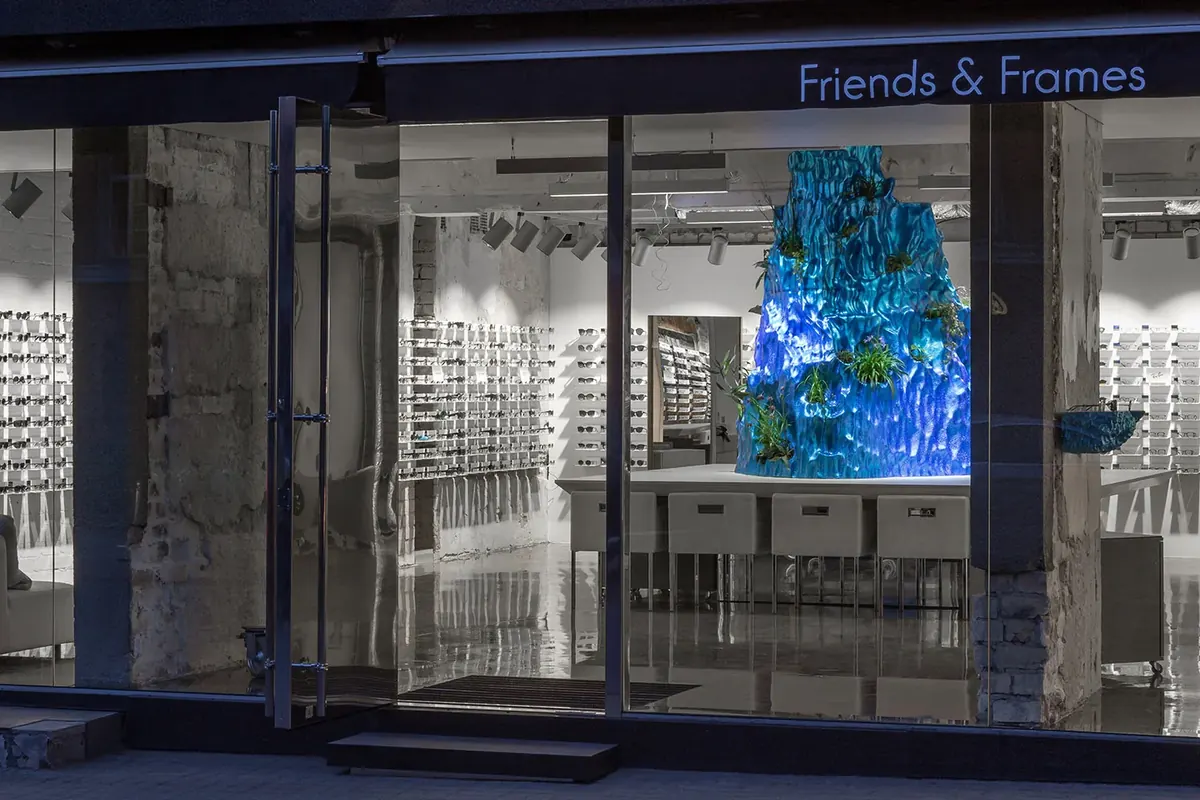
That makes beam control and aiming precision more important than raw output, and it makes the appearance of the luminaire itself part of the interior.
What this space needs
Short throws and small targets
Display walls in an optical shop are lit from a rail a short distance away, so a narrow optic is usually doing the work. Aim matters more than beam width: a narrowly aimed luminaire at the wrong angle leaves a bright patch on one frame and shadow on the next.
Reflective and transparent objects
Lenses, coated frames and glass shelves reflect. Where a luminaire is aimed straight at the display the customer sees the lamp rather than the product, so the light is normally offset and the frame is lit from a shallower angle.
Small interiors, visible ceiling
Optical shops are often compact with the ceiling fully on view. A large body on a short rail dominates the room, so the compact formats are the ones to consider first.
How to specify it
- Pick a colour temperature that stays neutral. Where frames have to be judged for colour, a consistent 3000 K or 4000 K across the display wall avoids the customer comparing two frames under two different lights.
- Use a narrow fixed optic for frame displays and a wider optic for counters and consultation areas, rather than trying to light both with one beam.
- Consider a zoomable luminaire where the display is reset between frames and shelving, so the same fitting can be re-focused rather than replaced.
- Keep the number of luminaire types low. A shop that runs on one or two body sizes and two beam options is easier to re-light later and reads as more considered.
Related pages
Buyer questions
Why does aiming matter more than beam angle in an optical shop?
Because the targets are small and close. A narrow beam aimed correctly lights one frame cleanly; the same beam aimed a few degrees off leaves part of the display in shadow. Buying a slightly wider optic and aiming it well usually beats a narrow optic aimed badly.
Should an optical display be lit from straight on?
Usually not. Frames are both reflective and transparent, so light aimed head-on produces reflections the customer sees. Offsetting the luminaire so the frame is lit from a shallower angle shows the frame instead of the reflection.
What suits a small shop with a low ceiling?
Compact bodies. The published TL03 format is the short one in the TL range, and a short body on a rail close to eye level is far less intrusive than a large one. Confirm the actual body dimensions on the current drawing before ordering.