
Track system guide · 2026-09-15
Why Track Lighting Is Replacing Recessed Downlights
Rising installation labour, multi-circuit rails and new fixture types are moving lighting off the ceiling and onto track. What store projects should plan for.
Direct answer
Lighting is moving off the ceiling and onto track because the expensive part of an installation is no longer the luminaire — it is the site labour around it. A mains track carries the supply inside the rail, so luminaires need no ceiling cut-outs and no individual wiring runs, positions can change without building work, and one multi-circuit rail can carry spotlights, wall-wash, linear and emergency luminaires together.
Information as of September 2026. Wiring rules, emergency-lighting requirements and ceiling load limits differ by country and must be confirmed for your project by a qualified electrical designer and the local authority. This article is not legal, electrical or structural design advice.
The cost that moved: from luminaires to installation labour
For most of the LED era the purchasing conversation was about the fixture: lumens per watt, CRI, price per piece. That conversation has largely finished. LED performance has converged, and the difference between two competent fixtures rarely decides a project. What decides it now is what happens on site.
The reason is straightforward: material costs are globally traded and visible, while site labour is local, regulated and rising. Eurostat’s labour cost index for the EU has continued to climb year on year, and electrical and ceiling work is exactly the kind of skilled site labour that gets more expensive first. A specification that shifts work out of the building and into the factory therefore gets better every year, without anything changing about the products.
This is the structural argument for track. It is not that a track spotlight is a better spotlight than a recessed downlight. It is that the installation system around it consumes far less of the item that keeps getting more expensive.
What “no ceiling wiring” actually means
The phrase is used loosely, so it is worth being precise about what a mains track system does and does not remove.
What the track removes:
- No individual supply run to each luminaire — the conductors are in the rail.
- No junction box, connector block or ceiling rose per fixture.
- No ceiling cut-out per fixture, and therefore no patching and repainting when a position changes.
- No need to decide final positions before the ceiling closes.
What the track does not remove:
- The rail itself needs power feeds. How many, and how far apart, depends on the load and the voltage drop — a 3-phase rail commonly takes a feed every 20 m or more, a single-phase layout may need one about every 10 m. The arithmetic is set out in our comparison of European and Chinese supermarket track practice.
- The host ceiling must carry the suspension load, at the spacing the drawing requires.
- The rail, adapters and luminaires must be bought as one system. Cross-supplier adapter fitment cannot be assumed.
Ceiling cut-outs are the part buyers underestimate. A recessed downlight is a hole in a finished surface: it is permanent, it is positioned before anyone has seen the merchandise on the floor, and moving it later means plastering, painting and out-of-hours work in a trading store. Track turns that decision into a mechanical one you can revisit.
Faster openings and lighter refits
Two moments in a store’s life decide the value of the ceiling system: the fit-out programme before opening, and every refit afterwards.
Before opening, the critical path is usually not the lighting products — it is the sequence of ceiling, containment, wiring, commissioning and snagging, with rent running throughout. Removing per-fixture wiring and cut-outs compresses that sequence. A Chinese supermarket lighting engineering contractor we work with reports commissioning on a bridge-free track fit-out compressing from two weeks or more to 3–5 days.
After opening, the same system is what makes a refit affordable. A brand refresh that changes layout, adds a category or moves a promotional zone normally means moving light. On a track ceiling that is a ladder and a repositioned luminaire. On a recessed ceiling it is a building project.
Planning implication: specify the rail for the store’s life, not for the opening layout. The rail and its feeds are the part that is expensive to change later; the luminaires on it are the part that should be easy to change.
One rail, every fixture type
Track has stopped being a spotlight system. The rail is now a busbar that carries whatever the layout needs, and buyers increasingly specify one rail family across several functions rather than several ceiling systems.
| Fixture type on track | What it does | What to plan for |
|---|---|---|
| Adjustable spotlight | Accent, merchandise highlighting, feature walls | Beam angle and aiming range; the TL01–TL05 range covers fixed and zoomable optics |
| Flood and wall-wash | Even vertical illumination, shelf and perimeter washing | Asymmetric distribution, spacing discipline, separate circuit from accent |
| Linear and ambient | Continuous lines, general illumination, architectural rhythm | Module length and rail continuity; linear housings and profiles are supplied in the housing kit range |
| Decorative and pendant | Brand expression, zone definition | Suspension load and ceiling height |
| Emergency | Escape route and anti-panic illumination | See below — this one is regulated |
The commercial consequence is that a track ceiling can be re-purposed without touching the building. The same rail that lights a supermarket today can carry a different fixture mix after a refit, which is exactly what a multi-circuit rail is bought for.
Emergency lighting on a track rail
Emergency luminaires are governed by IEC / EN 60598-2-22 and require a supply that cannot be switched off with the general lighting. This is normally solved at the rail rather than at the luminaire: on a multi-circuit rail, one circuit is reserved as a permanently live supply for the emergency luminaires, while the remaining circuits stay switched for general and accent lighting. That is one of the practical reasons to specify a multi-circuit platform rather than a single-circuit one, and it is a circuit-design decision, not a product decision.
Two points to settle before it is designed in. First, the emergency luminaire itself is a separately specified, compliant product — HAOTAI supplies the rail platform and reserves the circuit for it, and the luminaire is selected with its own documentation. Second, whether a track circuit may be used this way is a local wiring-rule and approval question; confirm it with the authority having jurisdiction and your electrical designer before the arrangement is fixed.
Why multi-circuit track matters more now
If the rail is going to carry the whole lighting scheme, it has to carry more than one switched group. That is the argument for multi-circuit track, and it has become stronger as the fixture mix has widened.
A 3-phase 4-wire rail does two jobs at once. Electrically it distributes the load across three live conductors sharing one neutral, so each conductor carries roughly a third of the current, the rail runs cooler and feeds can sit further apart. Functionally the same three conductors act as up to three switched groups, so general lighting, accent lighting and a night or cleaning scene come from one ceiling line instead of three.
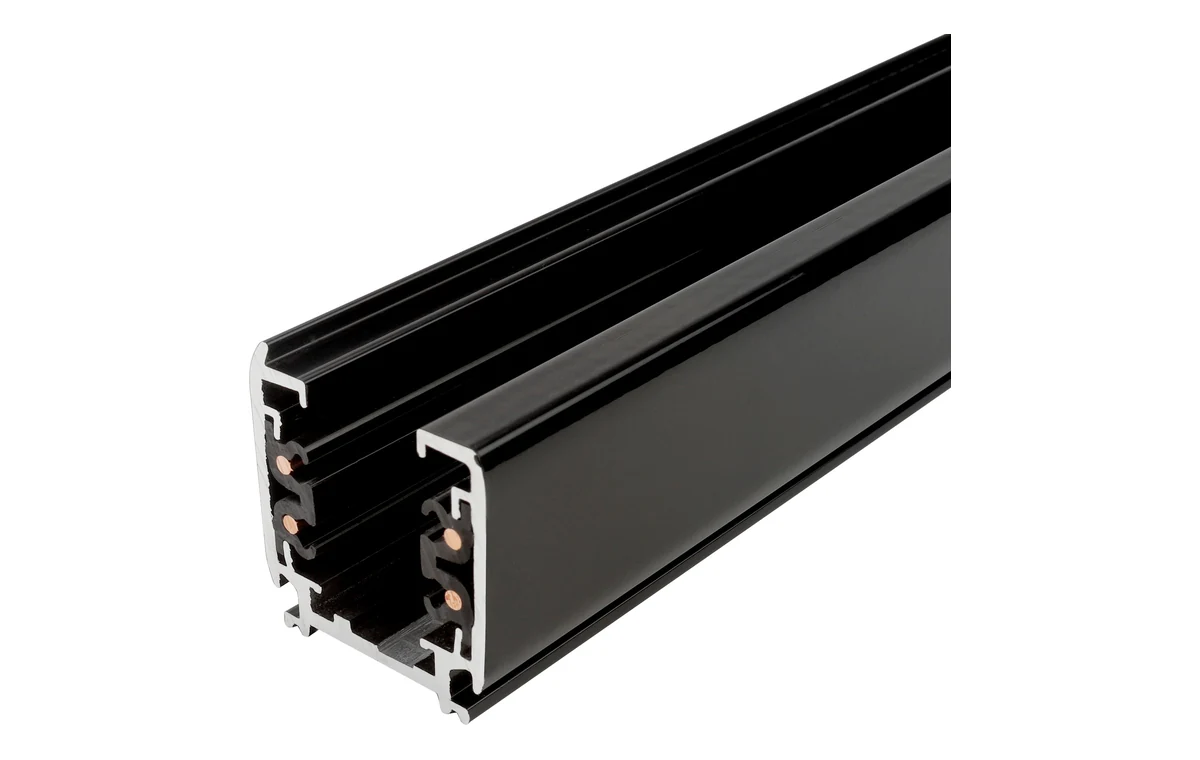
One rail, several jobs: a 3-phase 4-wire track platform with its matched surface connector range.
The trade-off is specification discipline: the three groups have to be planned and labelled, and load balance matters. Our single-circuit versus three-circuit guide covers the switching side, and the supermarket comparison covers the electrical side. The full rail, connector and adapter range is listed under lighting track rails. Where control wiring is required, a 3-phase DALI platform is the corresponding option.
Where track is not the right answer
Track is a system, not a universal answer. It is the wrong specification when:
- The ceiling is too low. Suspended track needs headroom below the structure; below roughly 2.4–2.6 m it starts to read as a low ceiling and to obstruct.
- The finished ceiling cannot take the suspension loads, or the suspension points cannot be placed where the drawing requires.
- The ceiling is architecturally protected — listed, heritage or decorative surfaces where new suspension points are not permitted.
- A wash-down or hygienic environment requires a sealed, flush ceiling with no exposed profiles.
- The lighting has to be genuinely invisible. Track is visible design; if the brief demands a flush plane, recessed is the answer.
- Very high bays or very long unobstructed runs, where a linear high-bay or continuous recessed solution delivers the same result with less hardware.
- Residential or hospitality briefs where the rail itself is not wanted visually.
Saying this plainly is part of the job. A supplier who recommends track for every ceiling is not solving a cost problem; it is moving it.
How to specify a track-first ceiling
- Fix the rail before the luminaires. Rail platform, profile standard, mounting method and finish are the decisions that are hard to reverse.
- Count the functions, then choose the circuits. If you need general, accent, night and emergency duties from one line, specify multi-circuit from the start.
- Have the feed spacing calculated, not guessed. Voltage drop plus per-circuit rating plus local rules — see the cost model.
- Confirm the adapter interface as one system with the rail and the luminaire on the same drawing.
- Plan the emergency requirement early, because it constrains the circuit arrangement.
- Keep the rail family stable across refits so later luminaires and adapters still fit.
- Put the questions you cannot answer in writing to the supplier — the buyer FAQ lists the ones that most often come back.
Frequently asked questions
Does track lighting really save money, or is it just easier to install?
Both, and the saving is mostly in labour rather than product. You remove per-fixture ceiling wiring, ceiling cut-outs and the patching that follows a position change, and you remove the need to finalise positions before the ceiling closes. The rail itself costs more than a plain ceiling rose, and a multi-circuit rail costs more than a single-circuit one.
Can linear lights and wall-washers go on track?
Yes — the rail is a supply and fixing platform, not a spotlight system. Linear and ambient modules, flood and wall-wash luminaires, and decorative pendants are all specified on track when the adapter interface and, for low-voltage systems, the driver arrangement match. Confirm the rail, adapter and luminaire as one system before ordering.
Is low-voltage magnetic track the same thing as mains track?
No, and the difference decides the project. A 230V mains rail carries the supply itself and needs no remote driver per run. A 48V magnetic rail needs a driver, and its modules are system-specific — the magnetic track range is confirmed with the rail and driver together. Magnetic systems are typically chosen where the rail is small and the modules change often.
Can I put emergency lighting on the same rail as the general lighting?
Mechanically yes, on a suitable multi-circuit rail, and it is common practice to reserve one rail circuit as a permanent supply for the emergency luminaires. The emergency luminaire itself must be a compliant product under IEC / EN 60598-2-22, and whether a track circuit may be used this way is a local approval question — raise it with your electrical designer and the authority before the design is fixed.
How far apart can the suspension points and power feeds be?
Neither is a standard figure. Suspension spacing follows the rail’s load rating, the luminaire load and the host ceiling. Power-feed spacing follows a voltage-drop calculation with the per-circuit current rating. One feed per 10 m and one feed per 20 m or more are project outcomes, not rules.
Sources and further reading
- Labour cost trend. Eurostat — labour cost index by NACE Rev. 2 and Eurostat labour cost statistics.
- Emergency lighting luminaires. IEC 60598-2-22:2021, luminaires for emergency lighting.
- Track system standard. BS EN 60570:2003+A2:2020, electrical supply track systems.
Talk to HAOTAI about your project
Technical requirements differ by market and installation. Confirm final drawings, electrical configuration, samples and applicable standards before purchase.
Request product information →